
Publisher is gone. So, what happens to your templates?
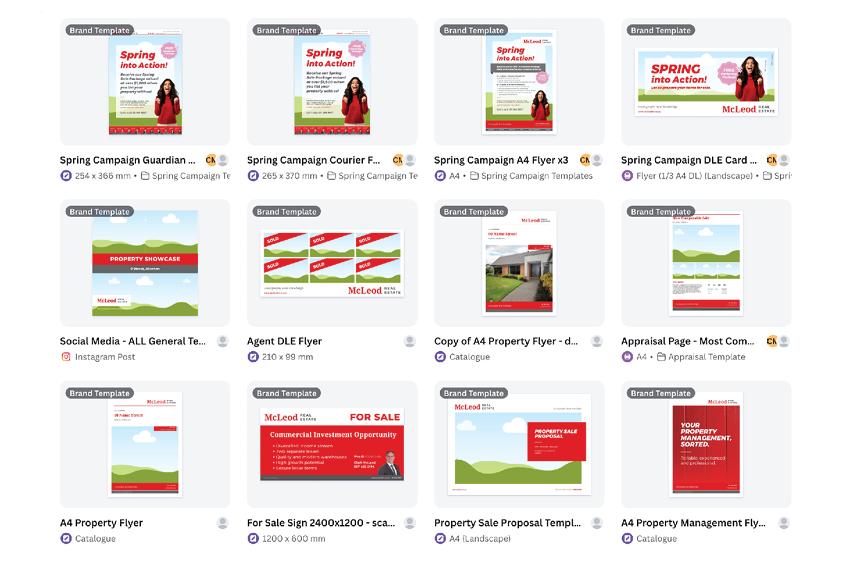
With the demise of Publisher coming in October, we’ve been busy setting up some on-brand templates for our friends at McLeod Real Estate.
A cohesive set of easy-to-use brand, campaign and proposal templates that make life a whole lot easier.
And while this particular project came about because Publisher is being retired, it’s also a good reminder for businesses to look at how their internal marketing materials are actually being created.
More than just a pretty Canva template
There’s a big difference between having a Canva template and having a properly designed Canva template system.
The goal isn’t just to put your logo on a page, pick a nice font and call it a template.
We’re looking at how your brand actually needs to work across different applications – your proposals, presentations, campaigns, social media, internal documents and marketing collateral – and creating a system that makes those things easy for your team to produce.
Fonts, colours, spacing, image treatments, layouts and hierarchy all need to work together.
That means when someone in the office creates something, it still looks like your business rather than something they fudged together in Canva at 4.50pm on a Friday.
Easy to use, easy to brand – things don’t shift 1cm and you don’t end up with fonts looking completely different on EVERY computer.
Yep, that’s you, Microsoft! 😂
Why Canva works so well for internal marketing
For businesses with someone managing their own marketing, Canva can be brilliant.
Your team can jump into an approved template, change the copy or images and get something out the door without needing a designer for every single little job.
It’s also easy to share, update and collaborate on, which is particularly useful when multiple people are creating content.
The trick is making sure the templates are designed properly in the first place.
Because giving someone Canva and telling them to “just make it look like the brand” isn’t really a brand system.
Canva isn’t InDesign – and that’s OK
There are still some limitations with Canva, particularly when you start getting into more complex layouts, style effects and print.
Layering is one of them. Some elements need to be exported from Adobe InDesign or Illustrator, compressed and then pulled back into Canva. This means they can still be used within the template while carrying through the brand style or design accents properly.
But if you plan the design properly around those limitations from the start, you’re already a few steps ahead – especially when it comes to avoiding print corruption and other little surprises when something finally gets sent to the printer.
Canva doesn’t need to do everything.
It just needs to do the things your team actually needs it to do well.
AI can make something. A designer makes it work.
And this is where we think the designer’s role is still pretty important.
In the ever-changing world of AI-generated content, DIY design and increasingly accessible design tools, it’s never been easier to make something.
But making something that is polished, consistent, readable, on-brand and actually works across different formats is another thing entirely.
AI and Canva are fantastic tools.
They just don’t replace good design thinking.
Sometimes you still need a designer’s touch to look at something and think:
Nope, that needs to move 5mm to the left.
That full-width block of text needs to become two or three columns so it’s actually readable.
That hierarchy needs to be changed so the key message is displayed correctly.
And yes, that’s what you pay an expert for.
Planning and executing the design properly in the first place so your job – and your team’s job – is made easier.
Building a system that works for your business
If your business has someone managing your internal marketing, we can create a set of on-brand Canva templates that actually work for your business – so they’re easy for your team to use, while still looking like you.
Rather than reinventing the wheel every time you need a proposal, campaign, presentation or marketing piece, your team has a ready-to-go system that keeps everything consistent.
And if something isn’t quite right? We can jump in and tidy it up.
That’s the beauty of having a properly designed system behind the templates.
Easy for your team. Consistent for your brand. And a whole lot less starting from scratch.
That’s the sweet spot. Find out more about the Brand Templates here.